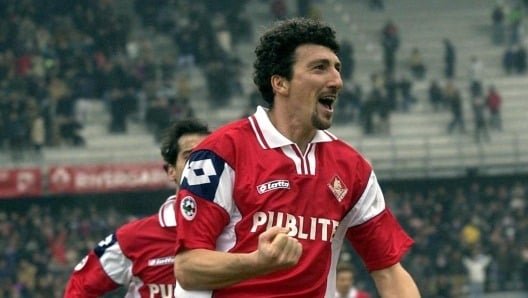
Tatanka recounts his life among coaching stints, grandchildren, and nostalgia. From his debut at San Siro against Inter to his regrets about the national team: “Look who’s playing for them today—I at least deserved one friendly match.”
Dario Hübner needed just two things to be happy: family and a soccer ball. “Sometimes I should do what Dario Hübner did,” sings Calcutta in a song dedicated to him, because “Tatanka”—or “Bison,” as everyone called him—went so far as to turn down the Premier League and a million-dollar contract in 2001 just to stay close to his wife and children. “It would have changed my life, but I was happy in Romagna and didn’t want to disrupt my family’s life,” he says. So he chose Piacenza, the team closest to his home in Crema. It was there, at age 35, that he tied with David Trezeguet for the 2001–02 Serie A scoring title, setting a record he still shares only with Igor Protti: being the top scorer across all Italian professional leagues. Today he lives just as he did back then: with his grandchildren, in the woods hunting for mushrooms, and on the bench with Zeta Milano.
How’s life as a coach?
“I’m enjoying myself. We’re in Seconda Categoria, and with the guys I have, I don’t have to work too hard. I don’t even know if I’d be able to coach a top-tier team. I see myself more as an assistant coach.”
Whose assistant would you like to be?
“I like Chivu’s Inter, but I think it would also be a great experience working with Gasperini or Allegri, who has his own unique coaching style. There are some great coaches in Italian soccer, which is why I follow it closely. I also watch Serie B and Serie C… sometimes they’re less boring than Serie A.”
This year, the all-time low for goals scored in a single matchday was set…
“Teams have realized that points matter right from the start. Back in the day, matches in the early rounds would end 3–1 or 4–2, but then you’d pay for those points lost in October come May. Now teams focus more on defense, and the smaller clubs play without taking risks: if you don’t win, at least you don’t lose. The problem has more to do with the style of play… sometimes I see too much ball movement: 15 passes just to cross midfield, then in the last three minutes, down by a goal, they start hitting long balls as if the game would never end. I don’t like that.”
Don’t you think what’s really missing are the goal scorers?
“We should get back to the level of the ’90s: in Serie A there were superstars, but even in Serie B there were incredibly strong strikers—Paci at Lucchese, ‘The Cobra’ Tovalieri, Marulla at Cosenza… Everywhere you went, you’d find a striker who could play in Serie A, but up there were the superstars, and you just couldn’t find a spot. Today, the pure center forward—the one who just puts the ball in the net no matter what—is slowly disappearing.”
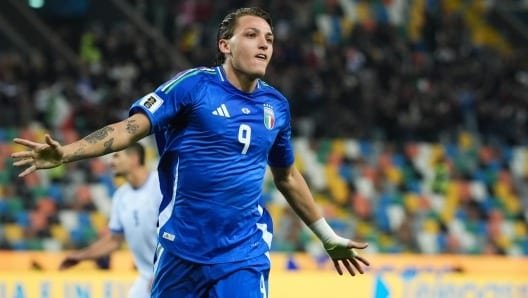
We had one, and he went to Saudi Arabia.
“Retegui made a life choice that I would never have made. Better to earn 4 million for ten years in Italy than 20 for two in Saudi Arabia, especially at age 26.”
Modric, on the other hand, joined our league at age 40…
“Luka is impressive. He shows us that not everything has to be about physicality and speed. He doesn’t run the 100 meters in 10 seconds, but mentally he thinks 100 times better than anyone else because he already knows what to do when the ball comes to him. I played with Pirlo: he wasn’t lightning-fast, but mentally he was a second ahead of everyone else.”
Where would Dario Hübner have played today?
“As a fan, I’d say Inter—I could have seen myself there. At one point in my career, I even came close: it was the summer of ’95, the year Moratti took over. I was playing for Cesena, and they wanted me as a third striker. The plan was for Marco Delvecchio to move from Venezia to Cesena, while I would go to Milan. But Roma got involved in the deal, and Delvecchio chose the Giallorossi. So I stayed at Cesena, he went to Rome, and Inter ended up signing Branca. Today, just like back then, I’d have struggled to get playing time: in the pecking order, I’d have been behind Pio Esposito (he smiles, ed.).“
It was actually against Inter that he made his Serie A debut.
”The night before the game (August 31, 1997), at midnight, in my room, I turned on the TV: Princess Diana’s accident. I stayed glued to the TV until three in the morning. The next day I was calm, almost not realizing what had happened: at 20 I was playing in Prima Categoria, at 35 I was in Serie A. I worked hard, without any handouts and without agents to help me jump five divisions. I walked onto the field at San Siro at 1:30 p.m., in front of 85,000 people, and scored the 1-0 goal. I didn’t realize it while I was on the field; after the shower, before getting on the bus, I lit a cigarette and said to myself, ‘Way to go, Dario—after 15 years, you’ve scored in Serie A.’ Actually, what made my evening less memorable was Recoba’s two goals. Because of him, we lost 2–1. Every time I see him, just to tease him, I say: ‘In ten years at Inter, you played three games—one of them against me. Couldn’t you have just stayed on the bench?’”

The very same game that marked the debut of Ronaldo “The Phenomenon”…
“I’ve met many great players—I’d say the best of all time—but only one true phenomenon: Ronaldo. Just once in 90 minutes did I try to pressure him: I saw he hadn’t controlled the ball well and went to steal it from him. As soon as I moved my leg, he was already a meter and a half ahead. I can’t explain just how good he was, but he was also an incredible person. After the game, he gave me his jersey, and I asked him for a photo. By the way… Can I share a story?”
Ronaldo, a phenomenon. Once I tried to press him: he hadn’t controlled the ball well; as soon as I moved my leg to steal it from him, he was already a meter and a half ahead
Dario Hubner
You’re welcome.
“Brescia vs. Milan: Paolo Maldini arrives in the underpass. ‘Dario, could you please give me your jersey?’ I thought he was joking. At the end of the first half, he was there waiting for me. Maybe he gave it to a friend (laughs—ed.), but if Maldini asks you for your jersey, it’s worth as much as a hat trick in Serie A. I have to admit that before I met great players, I met great men: Ferrara, Montero, Zidane, Maldini, Costacurta, Baggio… humble, down-to-earth people. Back then, anyone who acted out of line was immediately put in his place by the veterans in the locker room. No one dared to get a big head.”
Have you ever put anyone in their place?
“Ambrosini, back in my Cesena days. I was always ‘giving him a hard time.’ I was 25, he was 19; he’d come up from Bolchi to play with the first team. He was a phenomenon at heading, but when he kicked the ball… it was a disaster (laughs, ed.). He’d make me lose during scrimmages, so I’d give him a few ‘taps’.”

Who was the one who “gave you a hard time,” though?
“I wouldn’t call it a scolding, but tactically, Baggio and I just didn’t click. It was both a blessing and a curse to have played with him: he wanted a striker who played as a target man, while I loved making runs behind the defense. So Luca Toni came in to replace me. Beyond that, though, Roberto is a wonderful, humble person. We were the “workers’ Brescia,” and when he arrived—someone you’d only seen on TV until the day before—it was impressive. He had an extraordinary humility, and he fit right into the group as if he’d been there for ten years. Being around him was like training alongside your idol: he commanded respect, you were afraid of making a mistake, but he taught you without saying a word.”
That Brescia was Carlo Mazzone’s Brescia…
“Carletto was one of a kind. He gave you everything you needed, but in return he always demanded one thing: your absolute best on the field. Once we had to go to Perugia for a game, and the club wanted us to leave on Friday by bus, sleep in Cesena, and then head out again. Calori, Baggio, Bisoli, and I asked, ‘ Can’t we fly on Saturday morning?’ Carlo went to Corioni and suggested it. At the end of practice, he came into the locker room and told us: ‘Guys, no more buses—we’re flying on Saturday. But remember: I’m giving you this bonus, but on Sunday I want to see eleven lions on the field.’ We tied 2–2, but luckily I scored two goals.”
Do you have any regrets about the national team?
“At first I would have said no, because I had players like Baggio, Inzaghi, Vieri, and Totti ahead of me. Take Montella as an example: a guy who scored 15–20 goals in Serie A every year, yet played very little for the national team. Today, though, I say: they could have at least let me play in a friendly… I was hoping Trapattoni would call me up when Vieri got injured, but nothing came of it. It’s a shame because over the last 10 years I’ve seen players with just 5–6 appearances, and some even called up before making their Serie A debut, like Zaniolo. Back in the ’90s, if you didn’t have 200 Serie A appearances, you didn’t even make the national team. Back then, the problem was choosing whether to play Totti or Del Piero… Today we have to naturalize forwards because we don’t have any left.”

Is it the youth academies’ fault?
“Yes. I remember Cesena: 25 players from Romagna and the Marche region on the roster. In Brescia, there were players from Brescia, Lombardy, and Milan. We had so many strong Italian players. Every year, 5–6 players would come up from the youth teams ready to play: goalkeepers, defenders, midfielders, and forwards. Today, in the Serie A Primavera teams, there are too many foreign players. And then we wonder why we don’t win European Championships or World Cups: it’s a contradiction. Italy is also losing its goalkeepers: we have Donnarumma, and then what? Back in the day, there were Peruzzi, Buffon, Toldo… we had the best in the world.”
The attack is bringing a lot of joy and hope for the future of the Azzurri.
“Pio Esposito is very strong but young. You can’t truly evaluate a striker until he’s 25. He needs to grow and improve over the next five years. I remember Cutrone perfectly: in September, he was supposed to be Italy’s center forward; by January, no one was talking about him anymore. In my day, Paolo Maldini, at 18, had already been a starter for two seasons, and people said, ‘He’s a good player.’ Young players need to play and make mistakes. Camarda? I hope he gets plenty of playing time at Lecce, because otherwise it’s pointless. At that age, you have to cut your teeth. I would have gone to Serie B: 38 games, facing defenders who rough you up—you build up your physicality and score goals, then move up. In Serie A, 20 minutes won’t prove anything. He needs to follow Pio’s path: first work your way up from the bottom, then make the leap.”
At this point, it’s impossible not to ask you about the World Cup…
“I’m optimistic because Gattuso has the special gift of making players love the jersey—the element that’s been most lacking so far. In recent years, I’ve seen too many players called up go home because of ‘little problems.’ If Trapattoni had called me up with a pulled muscle, I would have played anyway and then been sidelined for a month. The national team is the national team.”