Following CAF’s incredible decision to award the 2025 Cup to Morocco, we revisit the events of the unbelievable final act in Rabat
The credibility of an entire movement has been seriously jeopardized. How is it possible to award the continental cup on a technicality two months later by upholding the appeal of the defeated national team—not due to a doping case or irregular registrations, but because of an incident that occurred on the field and therefore—at this point, one might say, only theoretically—in full view of everyone? According to the rules, it was a classic black-and-white case. There was very little gray area. Don King, the legendary boxing promoter, used to say “Only in America,” though he meant it in a positive sense. Here, one is tempted to say “Only in Africa,” with a heavy heart for those who dream of seeing this continent evolve—not just in sports.
Following the sensational decision by CAF, the African football federation chaired by Patrice Motsepe, to award the 2025 Africa Cup of Nations by a 3-0 default to Morocco—the host country (which will also host matches for the 2030 World Cup)—at the expense of Senegal, it’s worth revisiting what happened on the evening of January 18 at the Prince Moulay Abdellah Stadium in Rabat. With the score still tied at 0-0, the referee added eight minutes of stoppage time. Senegal’s hopes were raised by Gueye’s goal in the 92nd minute after Seck had hit the post, but the referee ruled that Seck had previously committed a foul on Hakimi. The goal was therefore disallowed. In the 98th minute, Morocco was awarded a corner kick: Brahim Diaz was fouled in the box, and the referee, Jean-Jacques Ndala of the Democratic Republic of the Congo, awarded a penalty—dubious to say the least—following an on-field review. All hell broke loose.
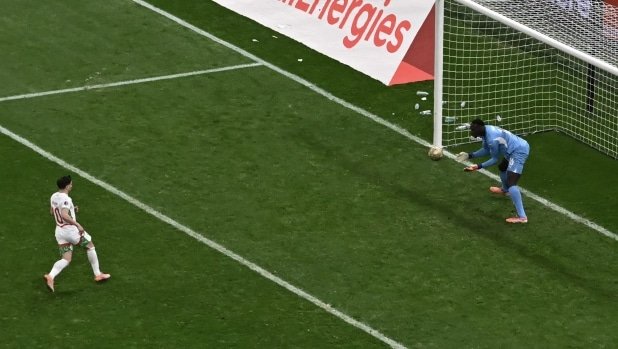
Senegal walks off— Tension on the field is through the roof. The Senegalese feel they’ve been robbed and refuse to accept it. After some scuffles among the players, Senegal decides to head back to the locker room in protest, as requested by coach Pape Thiaw. We’re now past the 8-minute mark of stoppage time when the Lions of Teranga leave the field to avoid taking the highly contested penalty kick. It’s Sadio Mané who convinces his teammates to return to the field to play out the very last minutes. Coach Thiaw also reappears on the field, first arguing with the referee and then being escorted back to his spot by Regragui, Morocco’s coach. In the 112th minute, Brahim Diaz stepped up to take the penalty. His attempt was comical: a chip shot that Mendy saved without even moving. Many wondered if he had missed on purpose… The match then went into extra time tied at 0-0.
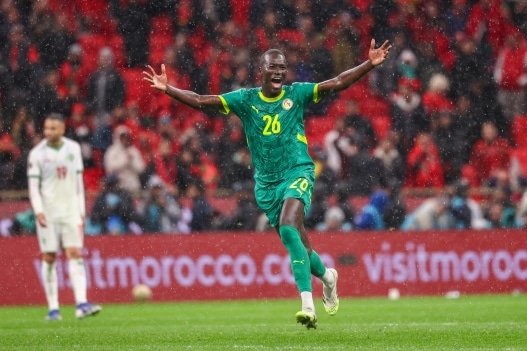
The towel and Gueye’s goal— Pepe Gueye’s goal in the 4th minute of the first extra-time period puts Senegal ahead. Shortly after, yet another episode in this final that is increasingly taking on the appearance of a farce. While play is stopped to attend to Roma’s El Aynaoui, who was injured in the head, Hakimi is urged by his fans to steal Mendy’s white towel. He takes it and throws it behind the advertising billboards. Diouf, the left back for the Lions of Teranga, immediately retrieves it and puts it back in its place. Play resumes. Yehvann Diouf, the backup goalkeeper, brings Mendy another towel—a blue one. Behind him, a group of ball boys appears, and one of them tries to snatch the colorful towel from him. The Nice goalkeeper won’t let go. Then Saibari arrives and tries to block his path. But Yehvann manages to dodge him and hands the towel to his teammate, who then returns it to him. The question naturally arises: why all this chaos over a piece of sponge? Because in those parts, it’s considered a powerful amulet—a matter of black magic. After all, “Only in Africa,” alas…
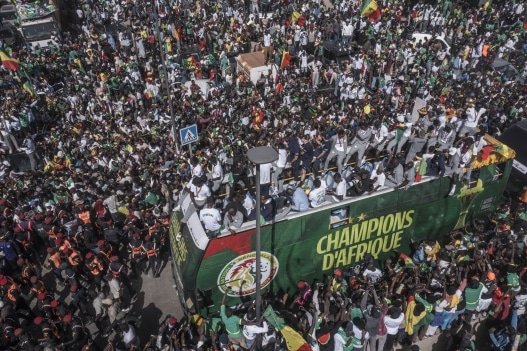
the celebration— At the final whistle, celebrations erupted, both on the field and in the streets of Dakar. Meanwhile, an entire nation—the Moroccan people—plunged into the deepest despair. It was a title they’d been waiting for since 1976, one that slipped away after they’d almost had it in their grasp. Or so they thought. That is, until the fateful appeal was upheld by CAF two months later. Who knows how Diaz (in the Etihad locker room after City vs. Real) and Hakimi (in the Stamford Bridge locker room after Chelsea vs. PSG) learned the news. But above all, what must the poor Senegalese have thought? A trophy for two, with an ending that can’t help but leave a bitter taste in the mouth. Perhaps even for those who found themselves lifting it—metaphorically.