The former center forward recounts: “When Giovanni Galli from Fiorentina called me, I thought it was a prank and hung up. The national team remains a regret; I was hoping for a call-up in Messina when I was the top scorer, but Donadoni didn’t call me.”
For a few years, a banner flew in the Fiesole stand that captured the weight of his impact during the toughest times: ‘God forgives, Riga-no.’ Christian was the hero of the comeback, the striker who helped Florence return to the map of top-tier soccer. He arrived in 2002; the club was in Serie C and was called Florentia Viola. Those were different times. “There was a mood of sporting despair in the city. A team with that kind of history had gone bankrupt over a few pennies.” Riganò scored goals by the bucketful right from the start. “I scored 30 goals in my first year; that’s where it all began.” Today, the former striker lives there and works as a bricklayer—the job he had before making his pro debut.
Christian is still an idol in Florence.
“Not at all, I’m just a normal person. I’m on the construction site from morning till night. People in the city love me, that’s for sure. I’m glad I gave them something. They stop me because I’ve always behaved well, not because I was a champion. And that’s what makes me happiest.”
His story is one of comebacks and climbs. He scored in every category before reaching the top.
“Back in my day, it wasn’t easy—you had to really fight your way up. A lot of people tell me I came along too late… I tell them I’m lucky to have made it. Do you know how many talented players get lost in the lower leagues? Especially back in my day. Today, you score five goals and you’re already worth 20 million. I’ve played and scored in every division—the only one missing is the third division. But I don’t care about records; they’re just a reminder of where I came from and what a journey it’s been. I’ve always had fun, even in the amateur leagues. And I’ve never been a big shot.”
Do you have any regrets?
“I’m not one to look back—I don’t like it. But I’d say I’m sorry I didn’t earn a call-up to the national team. It would have been the culmination of a wonderful journey. At the end of 2006, Italy played a friendly match during the time I was the top scorer in Serie A with Messina. I held out hope, but coach Donadoni didn’t call me up. Oh well. Back when I was playing, a striker had to hope for an epidemic just to make the national team… everyone would have had to get sick. Ahead of me were Del Piero, Totti, Toni, Di Natale, Iaquinta, and Inzaghi. And some of them even stayed home.”
Did being a genuine person cost you?
“I don’t know, but for me it’s a point of pride. I’ve never bowed down to anything or anyone. I’m someone who came from nothing, without hiding who I am. Can you believe I used to smoke right in front of the coaches…”
Did they ever call you out on it?
“Once, at a training camp with Fiorentina, Prandelli saw me take a couple of puffs: ‘How many cigarettes do you smoke?’ ‘Not many.’ ‘Then smoke fewer.’ But that was the end of it. Even with club presidents, I’ve always been frank and direct; I’ve never had any problems with anyone.”
At Fiorentina, the fans unfurled a banner that read, “God Forgives, Riga-no.”
“The penalty area has always been my natural habitat. I took no prisoners. That’s where my unforgiving nature comes from. When the ball reached the final sixteen meters, there was an unnatural, almost chemical attraction. In Florence, just like in Taranto and Messina. And to think that I’d started out playing defense in Lipari.”
Then, what happened?
“I was twenty years old, and we were struggling on offense: some players had left, others were away for work. The starting center forward got injured, so I went in to replace him. I had a blast—I scored right away, and they never took me out again. Thank goodness, I’d say.”
When you joined the Viola, the team was called Florentia Viola and played in Serie C. Those were different times.
“I was coming off a season in Taranto where I’d scored a lot; I wanted to move up a division, but the call from Fiorentina was special. President Della Valle reached out to me and made it clear that the goal was simple: to get back to the top quickly. And that’s exactly what happened. Actually, at first I got a call from Giovanni Galli; I thought it was a prank and hung up. But they really did want me. There was a sense of sporting despair in the city. A team with such a rich history had been relegated to the fringes of soccer, gone bankrupt over a few pennies. In my first year, I scored 30 goals, and that’s when everything took off.”
It was a wonderful journey.
“Two amazing seasons—the Florentines took me in. I still live here, and every now and then I catch myself speaking in the Tuscan dialect. And I’m from Lipari—can you believe it?”
After Florence came Messina, another happy chapter.
“I experienced some incredible moments; I scored 19 goals in Serie A and was the league’s leading scorer for a while.”
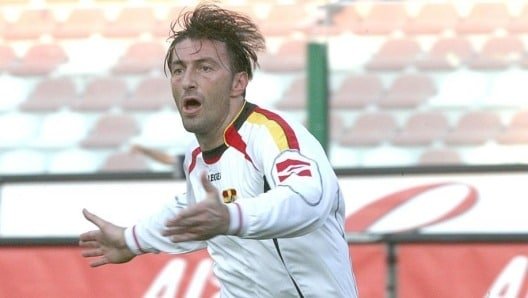
Those goals took him all the way to La Liga. In 2007, Levante signed him.
“We faced Barcelona—the team with Eto’o, Messi, Xavi, and Iniesta. Leo was young, but already incredibly talented. He even scored in that game. I brought home Henry’s jersey—a keepsake. It saddens me that I never played at the Bernabéu; that would have been a real source of pride.”
What is Riganò doing today?
“I’ve gone back to doing what I did as a kid: working as a bricklayer. In life, there are two things I’m good at: scoring goals and building houses. And it’s not like you can reinvent yourself and become someone else once you’re past forty. I’d go crazy if I had to sit still—I just can’t do it. But I also do it to make a living; I won’t deny that. I haven’t earned enough to live off my savings. I mean, if I had ten million in the bank, I’d live a more peaceful life.”