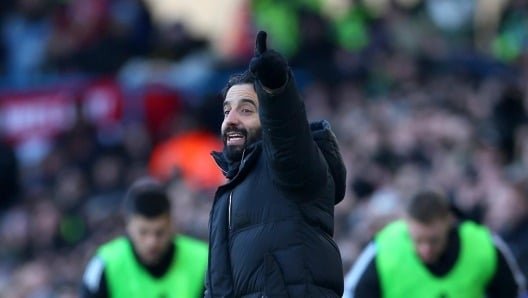
“I’m here to be the manager, not just the coach,” the Portuguese coach said yesterday. And this morning, he was fired. For now, assistant coach Fletcher is in charge
Ruben Amorim is no longer the manager of Manchester United. “With the team in sixth place in the standings, the club has reluctantly made the decision to make a change, believing this is the best time to do so. This will give the team the chance to finish the Premier League season in the best possible position,” the club announced in a statement released at 11:08 a.m. Italian time. The team, which plays at Burnley on Wednesday in the 21st round of the Premier League, will be led by Darren Fletcher for now, and the selection of a new permanent manager could be postponed until the summer. Behind the diplomatic language of the official statements, however, lies the reality of a sensational rift between Amorim and United’s management—one that played out in public and took on dramatic proportions, in perfect Red Devils style since Sir Alex Ferguson’s departure, a decade in which the number of trophies won has been far fewer than the number of managers who have come and gone.
Amorim made his stand yesterday, after the draw with Leeds. “I came here to be the manager of Manchester United, not just the coach,” he told reporters at Elland Road. “I want this point to be clear, and for everyone to know that this will be the case for the next 18 months or until the front office decides to make a change.” The dig at the front office was so sharp that United’s leadership, led by CEO Omar Berrada and sporting director Jason Wilcox, had already decided last night to fire Amorim, though they preferred to take a night to reflect before immediately announcing yet another shake-up. With those statements—the culmination of tensions that had become public even before Christmas—it was clear that the partnership between Amorim and United could not last. The Portuguese coach, who had been poached from Sporting in November 2024—where he had established himself as one of Europe’s top young coaches—for 11 million euros, had reluctantly decided to abandon the 3-4-2-1 formation on which he had built his success, partly because “if we were to buy the players I need to play that way, we’d have to spend a lot of money.” He had also reiterated in the press conference before the Leeds match that the club could not afford to accommodate his requests in the transfer market. Despite underwhelming results—and despite the 2024–25 season going down in history as the club’s worst-ever Premier League campaign (and its worst overall since the 1973–74 relegation)—the front office ultimately decided to sack Amorim because of what he said, as their relationship deteriorated at an increasingly rapid pace, before the astonished eyes of the press and fans.
failure— And so the Amorim era comes to a close after just 14 months as yet another managerial failure in the post-Ferguson era—the first official one of the Ineos era. It was also a financial failure, because, as stipulated in the contract, United will have to pay the Portuguese manager’s full salary until the agreement’s natural expiration at the end of June 2027. In November 2024, Amorim had been persuaded to leave Sporting mid-season to jump on the United bandwagon: he was supposed to be the turning point, including tactically, given that throughout his career he had always used a 3-4-2-1 formation, not the 4-2-3-1 on which the Red Devils had been built. The Portuguese coach weathered the string of disappointing results and criticism for his lack of flexibility—refusing to abandon a formation that was clearly ill-suited to the players at his disposal. Things on the field had been improving slightly this season, thanks in part to the 230 million euros spent in the transfer market to rebuild the attack, as well as the absence of cup competitions, which meant more time to train and absorb a new philosophy. Behind the scenes, however, the situation deteriorated rapidly, with Amorim reportedly displeased with some of the club’s transfer decisions (most notably, the selection of young goalkeeper Senn Lammens over Emi Martinez, whom the coach had specifically requested), and the rift between him and the club grew ever wider. The last straw for Amorim came when, before Christmas, the front office insisted on a change in formation, to which he reluctantly complied. From that point on, however, his barbs grew increasingly harsh and increasingly pointed. This culminated in his outburst against Leeds, the final straw for the club. His 14 months with the Red Devils remain an unfinished chapter—a wind of change that, rather than bringing improvements, has only made the situation worse. In true United style: all talk, all smoke, and no substance.