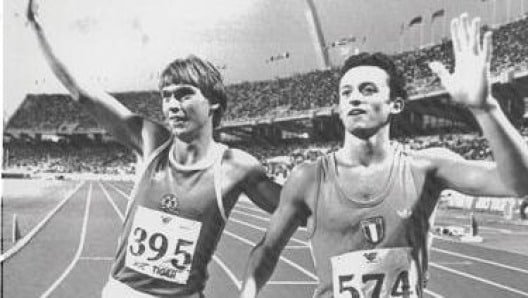
The Italian silver medalist in the 100-meter dash at the 1982 European Championships and in the 4×100-meter relay at the World Championships: “Vittori wanted me to be like Pietro, but I kept getting injured. Today, with my company, I’m fighting cancer”
It was the summer of 1982, Italy’s summer. Two days earlier, Saronni had become the world cycling champion at Goodwood. Less than two months earlier, at the Bernabéu, Bearzot’s national team had triumphed at the World Cup. On Tuesday, September 7, at the European Athletics Championships in Athens, a 19-year-old Italian won silver in the 100-meter dash: it was Pierfrancesco Pavoni, and when he crossed the finish line leaning forward, he reminded everyone of Pietro Mennea two years earlier in Moscow. “I didn’t do it on purpose. But it was certainly a conditioned reflex.”
Can you think during the 100-meter race?
“If you think, you slow down. You’re like a bull that has to move with the lightness of a butterfly; you have to feel what you’re doing—it’s something that comes from within.”
And to think he’d made it to the final with the slowest time.
“In the heats I ran 10.40 just messing around; I was going like a missile. So in the semifinals I took it easy, without thinking that a 70-kilo guy running into the wind would slow down. The others were twice my size. The usual idiot.”
What do you remember about the final?
“Everything, as if it were right now. I’d visualized the race; I wanted a fast start but one that wasn’t too energy-intensive. I get on the blocks—perfect—in a bubble of absolute silence, Woronin to my left and Sharp to my right. Then I did something crazy—I started off deliberately slow, building up the pace. The others pulled away, but I caught them all, one by one.“
One more meter and he would have won.
”My father always said that too. I lost four hundredths of a second just at the gun.”
Then what happened?
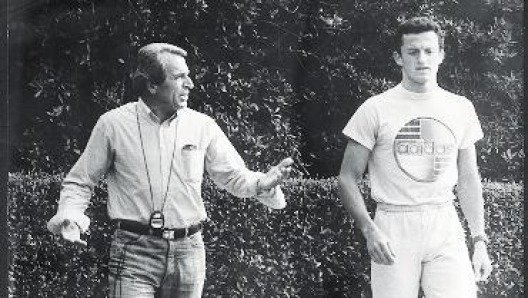
“Vittori started trying to move me up a category; he wanted me to be more powerful. He modeled me after Mennea, but I had different muscle fibers—for me, it was a disaster. You ask me for 10; the way I am, I give you 12, but maybe the right amount was 6. A disaster—I was killing myself.”
Why track and field?
“I was born near Villa Borghese, but my dad worked at EUR, so we moved to Ardeatina, near the city walls. I went to school on Viale Manzoni. I played soccer; there were a couple of lanes on the gravel path under the wisteria. We had this race—I must have been 7—and I was already winning. Years later, I moved to a boarding school in Paderno del Grappa with a friend. They asked me to run the 100 meters at the Youth Games. It was a dreary afternoon, in the middle of nowhere. I was wearing sneakers; it felt like those 100 meters would never end. I ran it in exactly 12 seconds.”
And from there to Athens?
“I was beating guys older than me. In provincial and regional meets. I never trained; I just raced, but I was driven. I went to the Italian Championships in Bologna; at the start, I had a two-meter lead on everyone, but I lacked endurance and the others caught up—I won by a hundredth of a second, but I won. The next year I ran 10.3, and at 18, 10.1, and I won bronze at the European Junior Championships.“
In Athens, he became a surprise like Paolo Rossi and Tardelli.
”I met them at an awards ceremony. Moser was there too. He kept pestering me with questions about Mennea—why he’d come back, what he might be capable of. I told him he was improving and would come back strong.“
The following year, in ’83, you were together at the World Championships.
”In the semifinals, I did my usual silly stuff, but that time I was the first one cut. I ruined everything.”
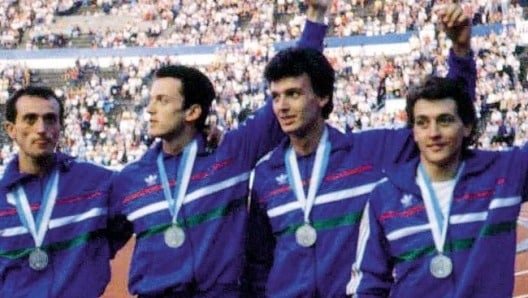
But you took silver in the 4×100, behind the United States: Tilli, Simionato, you, and Mennea. An Italian record (38.37) that stood for 27 years.
“I pulled a muscle passing the baton to Pietro.”
You retired early, at 28. Was it because of injuries?
“The real reason is something else. I had given so much to the world of sports and so little to the world of work. I had fallen behind my friends who had gone to college; after years of running with my legs, I thought it was time to run with my head.“
What did you do?
”I started a company using the technology that had allowed me to keep running despite my injuries. Radiofrequency machines that operate with very intense heat. I named my company Alba, because it’s a new therapy based on hyperthermia. I’ve dedicated my second life to this. In oncology, we use military-grade technology—specifically radar—to send an RF signal into the body to raise the tumor’s temperature above 41 degrees. This takes the fight against cancer to another level, and together with radiation and chemo, it destroys it.“
You like a challenge.
”As a sprinter, I was convinced I could beat the Black athletes. We felt immortal, invincible. Not succeeding shaped my character: I was always hungry, I faced significant mental pressure. My sons, Brando and Alessandro, work with me. They and Pilar are my life.“
Pilar Ottoz, still in athletics.
”I’m older; we’ve been friends for years, we played together, we laughed a lot. Then one day we became something else.“
Mennea had a kind of inner turmoil that drove him to do what he did.
”We all have that inner demon. Some express it, others don’t. Pietro was dedicated; he repeated the same things endlessly. I need to laugh.“
Why did Mennea come back after retiring?
”Because it’s beautiful. There’s nothing in the world like the 100-meter dash; it’s an insane sensory high. You have a fire in your chest; you risk your life in 10 seconds.”