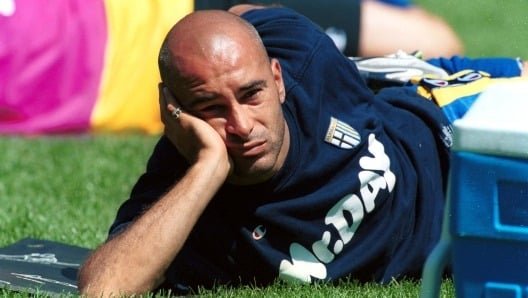
The former player for Bologna, Atlético Madrid, and Parma looks back on a career torn between talent and ‘distractions’: “While on loan to Marseille, I said I was out of commission, but I went to Saint-Tropez. I dreamed of Arrigo’s offsides”
It’s in the closing credits that you can read the whole story of his life. Stefano Torrisi stopped playing “at age 37, back home, for Ribelle in Castiglione di Ravenna, in the Prima Categoria. At a town meeting, we were talking about pay, and the pizza maker said to me, ‘If you play for us, I’ll pay you with forty pizzas.’ ‘Good deal,’ I replied, ‘on two conditions: two ankle wraps for every game, and I’ll only play the home games—on the road I hear too many insults and it takes the fun out of it.’ As a center forward, I scored nine goals and we won the championship. I still haven’t finished collecting my pay—I’m about twenty pizzas short.”
Rebellious: was that how you were throughout your career?
“Not exactly rebellious—more of a nonconformist, really. Becoming a soccer player—I was already 12 years old—was perhaps the only choice that was forced upon me. I was a promising tennis player, but back then tennis was a bit like golf—an elite sport: you had to have the financial means to travel the world, but my dad was a mechanic and my mom a homemaker, so I said yes to Russi, and by age 15 I was already playing for the Under-19 team.”
And at age 22, Milan signed you.
“In Modena and Ravenna, I’d already had three coaches—Ulivieri, Delneri, and Guidolin—who, given my style of play, were even better coaches than Sacchi. With Capello’s Milan, I only went on one tour—six games—but there were players like Baresi, Costacurta, and Maldini: I realized I wouldn’t have played even a single minute, so I asked to be sent out to play.”
But whenever he played against Milan, it always hurt him.
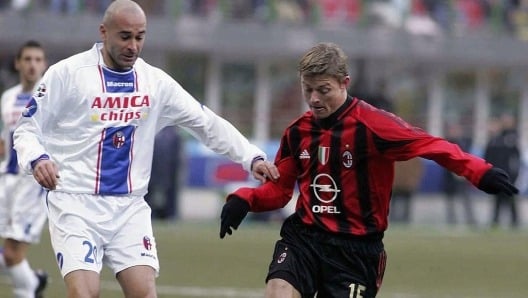
“A goal scored with my knee while playing for Reggina; the 16th, decisive penalty kick in the Coppa Italia quarterfinals in 1995; the Italian Super Cup with Parma in 1999.”
More than forty years ago, he was a tennis prodigy, and today he’s among the best in the world of padel.
“But in padel, I’ve never won a match while having a heart attack. August 2024, a tennis tournament in Milano Marittima; while I was playing, I felt a sharp pain in my stomach, then a stabbing pain in my left arm, but I didn’t stop: there are warning signs you don’t want to hear, and you do everything you can to convince yourself it’s not what you think it is. You can’t imagine the scolding I got from the head of the cardiology department in Ravenna: ‘You nearly had a heart attack, you know that?’ “But I won 6-2, 6-1.” That heart attack was a wonderful experience.”
What do you mean?
“Perhaps for the first time, I prioritized what really matters: the people who care about me, the joy of having them close by. And I looked back: the mistakes I made, the choices I could have made. But I feel very at peace when I think back on my career: a soccer player, yes, but also a man who wanted to live his 20s, 25s, even his 30s.”
A nonconformist, indeed.
“I was among the first to wear an earring—I wanted it so badly that I made a vow just to have an excuse; to get a tattoo—Michele Padovano took me to get it done in Reggio Emilia; to bleach my hair, to copy Vialli, who’d gone blonde for Sampdoria’s Scudetto; and to sport mohawk-style crests, even colored ones.”
And his toenails painted red and blue, when he played for Bologna.
“The summer after we finished seventh: the beach in Milano Marittima was full of people from Bologna, and word got around. But look—I still paint them, at almost 55 years old; last summer they were black. And there’s a reason: we soccer players have disgusting toenails, and just as people look at women’s behinds, they look at our feet. It’s a matter of decency.”
And when did you used to go out in a kilt?
“Or in my pajama bottoms at the disco: I’d sleep until around midnight, walk in through the back entrance of the Pineta, chat with Bobo Vieri and my friends, and head back to bed. That place was a cult spot for many people’s careers, and that’s where I met my ex-wife, with whom I had two children and opened a clothing store in Prague.”
Separated?
“We’ve been in the process of separating for two years. It’s a life experience: the Catholic faith teaches you that you have to get married, but it doesn’t teach you how to get separated.”
He also played alongside Bobo Vieri at Atlético Madrid.
“It was there, with 24 goals in 24 games, that Christian became Bobo Vieri. I joined too because Arrigo Sacchi wanted me; we lived together in his apartment—which used to be Esnaider’s place—but it only lasted a month. After training camp, we were in Milano Marittima; they were expecting us back in Madrid for the Atlético-Lazio friendly, but we hit traffic on the highway, missed our flight from Venice, and arrived a day late. Sacchi sent us to the stands, where the Lazio executives ended up surrounding Bobo: he wanted to stay, and they convinced him that very evening.“
Complicated relationship with Sacchi, huh?
”I’d done well at Bologna, and to get information, he called Ulivieri, who—biting his tongue—showered me with compliments. But when he called me, I told Arrigo: ‘Coach, if you want a good player, I’m here, but I also want to have fun: if anything, judge me on the field, not for what I do off it.’ Twenty minutes later, Renzaccio called me: he emphasized the phrase ‘You’re a dickhead’ so much that it took him twenty seconds to finish it. ‘Now call him back, tell him you’re happy to go, and be a good boy.’ Social media hadn’t changed everything yet: back then, the less you showed your face, the better; today it’s the opposite.”
Halfway through that season in Spain, he did everything he could to return to Bologna.
“After the first half of the season, I was exhausted: the training pace was unsustainable, Sacchi had switched me between four different positions, and I couldn’t sleep at night because I kept dreaming about offside calls. And then the magazine ‘Hola!’ spotted me—I ended up on the cover with a Spanish star, and Arrigo lost his temper. ‘Coach, I’ve been on my best behavior so far, but this was just too good—I couldn’t resist.’ And he said, ‘How dare you talk to me like that—didn’t you come to a single Spanish class?’ ‘Evening classes—you learn better that way.’”
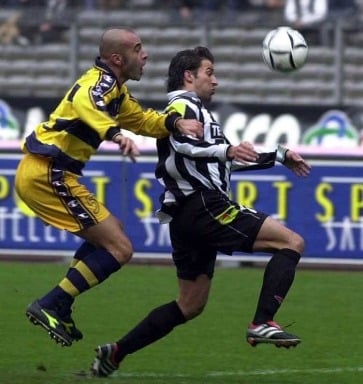
After Atlético, Parma. The joy: the only trophy he’s ever lifted in his career.
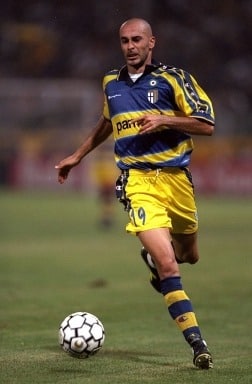
“I was privileged no matter what. Even back then, Malesani—who, for some reason, ended up being ‘branded’ with a negative image—was teaching the style of soccer that everyone plays today. And I played in front of Buffon, with Thuram and Cannavaro by my side: I could go out at night—the important thing was that they didn’t. Back then, Juve also came calling; Massimo Brambati, who worked for Moggi, asked to meet with me: he would have signed me if I’d given the power of attorney to his son Alessandro, but I was happy with Giovanni Branchini and didn’t like that kind of dynamic.”
The stain: the nandrolone scandal.
“Perhaps the only sad chapter of my career: a five-month suspension and a 50-million fine; I found myself with my back against the wall and defenseless. They’d given us something—perhaps a substance contained in supplements: me, Davids, Couto, Guardiola—more than twenty players in all, too many for it to be a coincidence. I remember with a smile only the humanity of the prosecutor who charged me, Aiello: for him, the important thing was to understand how this nandrolone had been given to us.”
The best player I’ve ever played with? It would be easy to say Baggio, but for me, what matters most is what you win: Cannavaro won the Ballon d’Or, but he also won the World Cup.”
Davide Torrisi
The six months at Marseille?
“Two months, actually, because then I ‘ran away.’ I told the Marseille folks I had to get the screws removed from my knee back in Italy; to Sacchi, who’d loaned me out, I said the coach wasn’t giving me a chance. Starting in March, I took four months off in Saint-Tropez: I had a lot of friends there…”
Things went better with Reggina.
“Sacchi, Foti, and I talked about it in a room; Arrigo was praising me as if I were a phenomenon. I told him, ‘Director, could you step out for a moment?’ I looked at Foti: ‘If all that were true, I’d be a starter at Parma—he just wants me out of his hair.’ That’s how a great relationship with Lillo began, and we stayed up for two years. But Bologna was in my heart.”
Trezeguet played on the first touch—no dribbling, just that “rubber band” movement. But the trickiest one was Pippo Inzaghi: back in our day, they sometimes didn’t call offsides.”
Stefano Torrisi
And he returned there, finding Mazzone.
“Perhaps the greatest motivator I’ve ever had—he trusted us and brought out the best in the more experienced players: me, Petruzzi, Marocchi, Fontolan, Signori. People had spoken ill of me to him, and he told me so, but then he admitted he’d changed his mind.”
The best player he ever played with?
“The easiest thing would be to say Baggio, but for me, what matters most is what you win: Cannavaro won the Ballon d’Or, but he also won the World Cup.”
The “craziest” one?
“More than anything, I had fun-loving teammates. Me, Bosi, Doni, Olivares, and Scapolo in Bologna: as kids—not ugly, rich, and famous—living in that city was a dream.”
So, what was the craziest thing you did?
“Once we went too far with the masseur, Balbino Spadoni: we stripped him naked and tied him to a pole on the field in Sestola” .
Who was the hardest to mark?
“Trezeguet: he only played first-touch, no dribbling, but that ‘rubber band’ movement of his. But the most complicated to mark was Pippo Inzaghi: back in our day, they sometimes didn’t call offsides.”
The national team was a one-night dream.
“Four call-ups under Cesare Maldini, who’d coached me on the Under-21 team, and one appearance—the pre-World Cup tournament in Paris in 1997: it was a dream, and I got to live it. For me, consistency was never what mattered—it was about achieving my goals. And I had the career that was meant to be.”
But given the way he played, would Torrisi make the national team today?
“In today’s soccer, I really think so. I started out as a left-sided midfielder; Ciapina Ferrario turned me into a defender at Modena because whenever I scored in practice matches, I didn’t want to lose, so I’d drop back to defend. Under Ulivieri, I went from being a stopper to a playmaking center back: they called me the new Baresi, but my role model was Fernando Hierro. Technically, I was similar to Bonucci: ambidextrous, no fear of having the ball at my feet, good vision—not as strong in the air as he was, but faster in open spaces. Rather: how would today’s players fare in yesterday’s soccer, with yesterday’s rules and “restrictions”? Today, Ronaldo “The Phenomenon” would score three goals per game every time—I’ll bet on it.”
You have your UEFA coaching license: is that idea off the table?
“It was never even an option, to be honest. It’s too exhausting; you’d have to give up too many things, and Coverciano churns out too many coaches: 10% coach because of their merit, 40% because of their name, and 50% because they’re part of a ‘system.’ And I—otherwise I wouldn’t be a nonconformist—don’t have any sponsors…”