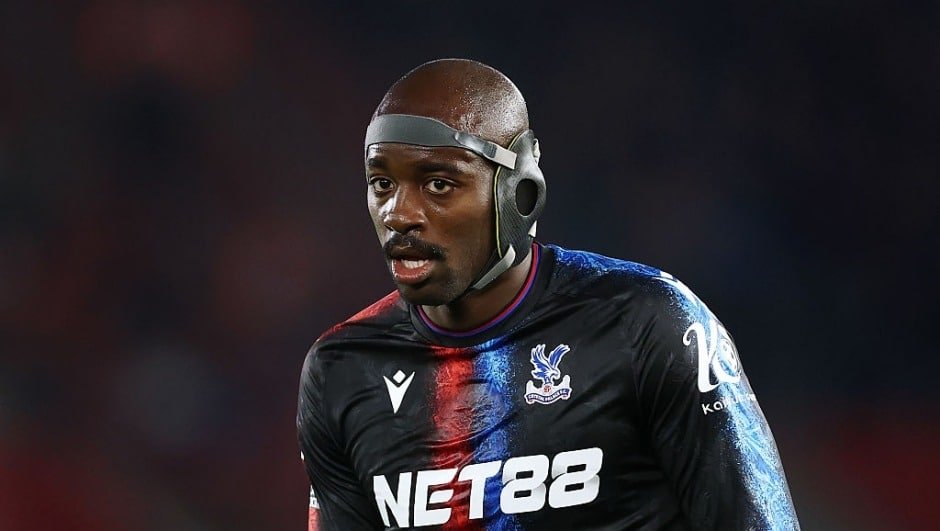
The striker used one that was very different from other protective gear seen on players’ heads, as Dr. Zenga and Professor Garbossa explain.
Jean-Philippe Mateta is now only talked about in terms of the transfer market: first Juventus, now Milan, many would like to take home the Crystal Palace striker. Just under a year ago, however, Mateta risked his career and his ear due to a crazy tackle by Liam Roberts, Milwall’s goalkeeper. It was March 1, 2025: a very strong tackle, an ear practically destroyed (“The doctor who operated on me didn’t want me to see the photos so I wouldn’t fixate on them; it was practically no longer an ear,” said the striker), surgery to reconstruct it, 25 stitches and a lot of fear, not least because such a blow could have caused him to lose his ear and perhaps even end his career if the studs had hit his face: “I could feel it dangling. It was all open and cut. It was crazy, my reflexes saved me by dodging the foot at the last moment.”
For this very reason, Mateta returned to the field wearing a special helmet: not the typical rugby helmet, also used by Petr Cech and Christian Chivu years ago, but a special protection more similar to that worn by water polo players, specifically designed for the ear area. As Dr. Francesco Zenga, neurosurgeon and Director of Basicranial and Pituitary Surgery at Le Molinette Hospital in Turin, explains, “rather than a ‘classic’ helmet, used to protect against head trauma, this is a real protection for the ear affected by the injury. Moreover, it is protection shaped to the exact form of the footballer’s ear, made specifically to protect it considering the blow he had received: he had already risked losing his ear, and a new blow to the injured structure could further worsen the prognosis. Looking at it, it even looks like a neoprene protector, a ‘molded’ and protective material that must be soft so that the player can take to the field. However, it is a different device from classic helmets; here, there is no protection from head trauma, it is designed specifically for the ear.”
The protection used by Mateta, a sort of headgear rather than a real helmet, therefore has a very specific role, as explained by Professor Diego Garbossa, professor of neurosurgery at the University of Turin and Director of Neurosurgery at the City of Health and Science in Turin: “In this case, we have damage mainly to the ear and—perhaps—also to the mastoid bone and temporal bone. This type of helmet protects both the soft tissues, i.e., the reconstructed ear, which would otherwise be exposed to further trauma, and the bones from possible further damage, especially in the first few months after reconstruction. Consolidation must take place physiologically but takes time, even months, so it is very important to avoid further trauma, and this type of protection serves precisely this purpose.” From Cech to Osimhen to Pellegrino: helmets and masks—More and more soccer players are now using special, customized protection, depending on their injury. The first to be remembered was Czech goalkeeper Petr Cech, who wore a helmet for the entire second half of his career due to a skull fracture, then came Osimhen’s ‘mask’, and most recently Parma striker Mateo Pellegrino has also used a helmet similar to that worn by rugby players: “This type of protection is now widely used in competitive sports,” explains Dr. Zenga. “We must always remember that these helmets reduce the energy of the impact, so a moderate or minor head injury can be nullified, but obviously they are useless against serious head injuries. These helmets are mainly used to protect players from repeated trauma over time, which is one of the big problems in professional sports.”
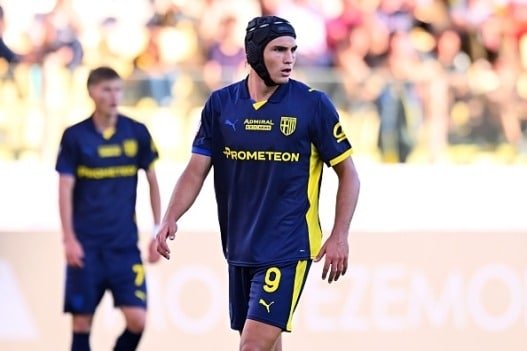
Mateta’s protection, on the other hand, is much more reminiscent of the now famous “mask” used by Osimhen: “These devices are now increasingly used in contact sports because they allow athletes to return to the field more quickly and safely,” continues Professor Garbossa, “because we must always remember that when a trauma is sustained, the fracture takes months to heal and there is always a small point of weakness in the maxillofacial area exposed to contact. At these levels, all protective equipment is highly customized based on the injury and the player’s build. In some cases, classic ‘helmets’ like those worn by rugby players are used, but in the case of orbital bone injuries, as in Osimhen’s case, they can become actual masks. The goal is always to prevent the affected area from receiving further trauma. A few months ago, I operated on Juventus Primavera goalkeeper Riccardo Radu after a bad orbital-frontal trauma, and now he plays with a mask even bigger than Osimhen’s because he has to protect a larger area. In Mateta’s case, to go back to the beginning, we are talking about protecting a more specific area.