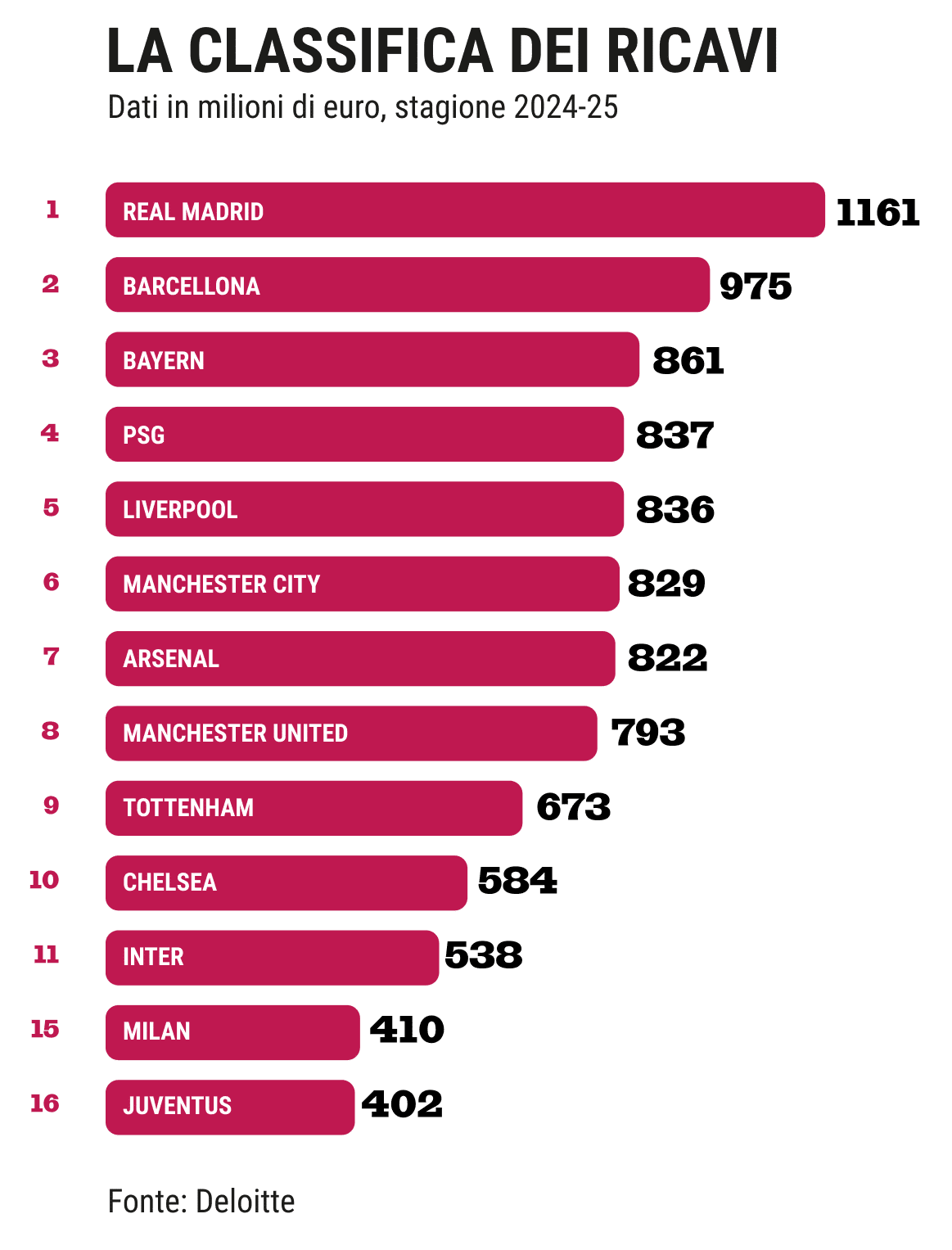
Deloitte’s analysis of the 2024–2025 season: The Blancos dominate the standings, with Bayern and Barcelona also on the podium. The Premier League is well-represented in the rankings; the Nerazzurri, in 11th place, are the top Serie A club
Real Madrid continues to lead the European revenue rankings, ahead of Barcelona and Bayern Munich. No Italian clubs made the top ten, despite Inter’s run in the most recent Champions League. This is the picture painted by Deloitte’s Football Money League for the 2024–25 season. The Blancos have reached 1,161 million euros, the only club in the world to surpass the billion-mark, with a 23% increase in commercial revenue. Barcelona returns to the podium in second place at 975 million, driven by the sale of premium seats (a one-time 70 million) at the new Camp Nou, which is not yet completed. Bayern also performed well (861 million) thanks to Club World Cup prize money. The top ten continues with PSG (837 million), Liverpool—at its highest ranking ever (836), Manchester City, down 1% (829), Arsenal (822), Manchester United (793), Tottenham (673), and Chelsea (584). Six Premier League teams, two from La Liga, one from the Bundesliga, and one from Ligue 1. Inter leads the Italian clubs at 538 million, ranking 11th. Next is Milan, in 15th place with 410 million, and Juventus, in 16th with 402. Deloitte analysts write: “The rise of certain clubs in the Saudi Pro League and Inter Miami from Major League Soccer represents a commercial challenge for Europe’s top clubs. For MLS, in particular, capitalizing on this opportunity after the 2026 World Cup could be the key to opening up a new fan base in the United States. We may soon see clubs from these leagues appear in the Money League as the world’s highest-revenue clubs.”
SCENARIO— Overall, the top 20 clubs generated over 12 billion euros in revenue (12.4 billion) for the first time, marking an 11% increase compared to 2023–24. For the third consecutive year, commercial revenue accounted for the largest share of the total, averaging 265 million. Deloitte analysts added: “The main drivers of this result were improved commercial performance, increased sponsorship revenue, and the use of stadiums and playing fields on non-match days. The latter represents a significant shift in the business models of some clubs, which are focusing on greater utilization of stadium resources through a diversified entertainment offering. Breweries, restaurants, hotels, and other on-site offerings are therefore becoming more common, demonstrating the importance for clubs of expanding their revenue-generating opportunities and highlighting that soccer clubs’ brands and facilities continue to evolve and now extend far beyond what happens solely on the field.” The stadium is increasingly becoming a key factor in economic performance. Italian clubs, unfortunately, know this all too well.