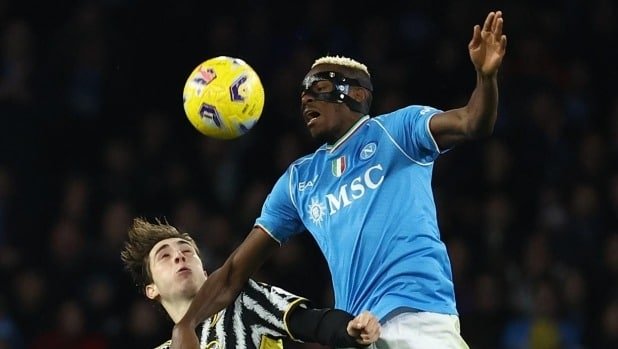
Repubblica publishes several messages between the former sporting director, his deputy Pompilio, and CEO Chiavelli which, according to magistrates, confirm their intention to inflate the figures of the deal with the complicity of Lille.
“Let’s hope they refuse… otherwise we’ll have to resort to robbery.” The Osimhen deal between Lille and Napoli is back in the spotlight in light of chats revealed in today’s edition of Repubblica, involving Napoli CEO Andrea Chiavelli, then-Napoli sporting director Cristiano Giuntoli, and his deputy Giuseppe Pompilio. These documents are part of the report by the Guardia di Finanza (Italian Financial Police) contained in the file of prosecutors Lorenzo del Giudice and Giorgio Orano, who have requested the indictment of Napoli president Aurelio De Laurentiis and CEO Chiavelli for false accounting. The preliminary hearing is set for November 6. From a sporting point of view, the Italian Football Federation closed the case in 2022.
According to the allegations, in order to reach the €70 million requested by Lille, with the approval of then French president Gerard Lopez, the cards of third goalkeeper Karnezis and several young players (Luigi Liguori, Claudio Manzi, and Ciro Palmieri) valued at a total of 20 million, but then immediately loaned to Serie C and D teams and never actually even traveled to France. It was in this climate that, on July 17, 2020, Chiavelli and Giuntoli were exchanging the first drafts of the agreement with Lille, and the CEO let slip the above remark. A few minutes later, his deputy Pompilio sent a message to the then sporting director. “I’m holding off,” wrote Giuntoli, “in fact, he told me to send it, hoping they wouldn’t accept. I have to talk to Aurelio. What a terrorist.” “This is psychological terrorism,” replied Pompilio. “Terrorist. Write that we were lucky that Amrabat and Kumbulla didn’t want to come,” Giuntoli insists, making it clear how limited the transfer budget was. “Otherwise, we would have had to play the championship with Petagna.” “You mustn’t write anything,” Pompilio warns. “Don’t leave any traces in the emails. Say whatever you want verbally.”
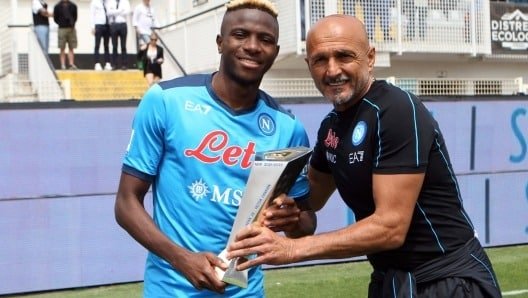
The Osimhen-capital gains case: Lille’s doubts— However, according to Repubblica, there are many traces in the Guardia di Finanza’s report. From the email in which the former president of Lilla “proposes” to ‘inflate’ the deal (“This, my dear friends, allows you to pay a lower price than any other club, but with a nominal value that is necessary to close the deal”) to the long discussions about the players to be included in the deal: starting with Llorente, moving on to the Brazilian Leandrinho and Ounas, and finally arriving at the formula with Karnezis and the three young players. However, someone was suspicious. It was Lille’s administrative and legal director, Julien Mordacq, who sent this message to the then CEO of the French club, Marc Ingla: “It is my duty to warn you again about the risks associated with this deal, based on the elements I have explained to you verbally. Any detail considered ‘strange’ could raise questions about these transactions as a whole (agreements relating to five players), and it will be necessary to provide real answers and justifications.” Napoli’s lawyers on the Osimhen case— “There is no evidence of any illegal activity, but rather the normal dynamics of negotiations related to the sale of players, which is common in the industry and not criminally relevant,” Napoli’s defense team replied today in a statement, expressing “astonishment” at the publication in the press of “investigative documents which, by their nature, should have remained confidential” and whose publication “expressly violates the prohibition established by law, contravening the principles of confidentiality and protection of the right of defense.” For lawyers Gino Fabio Fulgeri, Gaetano Scalise, and Lorenzo Contrada, these are “phrases taken out of a much broader dialectical context, which only when considered in its entirety and with calm objectivity allows one to grasp their real meaning.” The lawyers also point out that, “as further proof of the total irrelevance, for the purposes of the prosecution, of the statements reported in the article, it is worth noting that the same interlocutors referred to by the journalist have already been extensively heard by the public prosecutors, and this solely in their capacity as persons informed of the facts.” And on that occasion, “they provided detailed, clear, and convincing explanations, such as to exclude any actual evidentiary relevance of the same.”