Gattuso’s national team can secure second place. Qualification will be decided at the end of March, with the draw in November. There are many possible combinations, so keep an eye on the rankings too.
Destination: playoffs. Italy’s second star on the right, and then straight to the World Cup, could only be the playoffs. Once again, the third in a row. After the blow in Oslo, first place was gone: the wrong game at the wrong time, with a coach far from the team, players in pieces, and a Norway that, as seen against Israel, is one of the four strongest national teams in Europe. We got caught out and now we are outsiders, relegated to the virtual second tier. With Gattuso, to use his own words, we have had a wake-up call, with three wins, thirteen goals, a few defensive lapses, but the goal is medium-term. To build a team that will finally get through these damn playoffs in March and take us to the World Cup after twelve years. It can be done.
Starting with Israel.
Tomorrow in Udine, we have the match point to turn the two November games—Moldova away and Norway in Milan—into experiments for the future. After Haaland, in fact, we won’t play for four months. These are the scenarios. 1) Beating Israel, a result within reach, would mean second place mathematically and goodbye to the calculations that have plagued us since June. 2) With a draw, the situation doesn’t change much: we remain favorites, three points ahead, and a draw between Moldova and Norway is enough to reach 14 points, which Israel could never catch up to. 3) It’s a completely different story if we lose, not least because it would be a difficult failure to bear. In this case, finding ourselves level on points after Udine (12), we would need 4 points between Moldova and Norway.
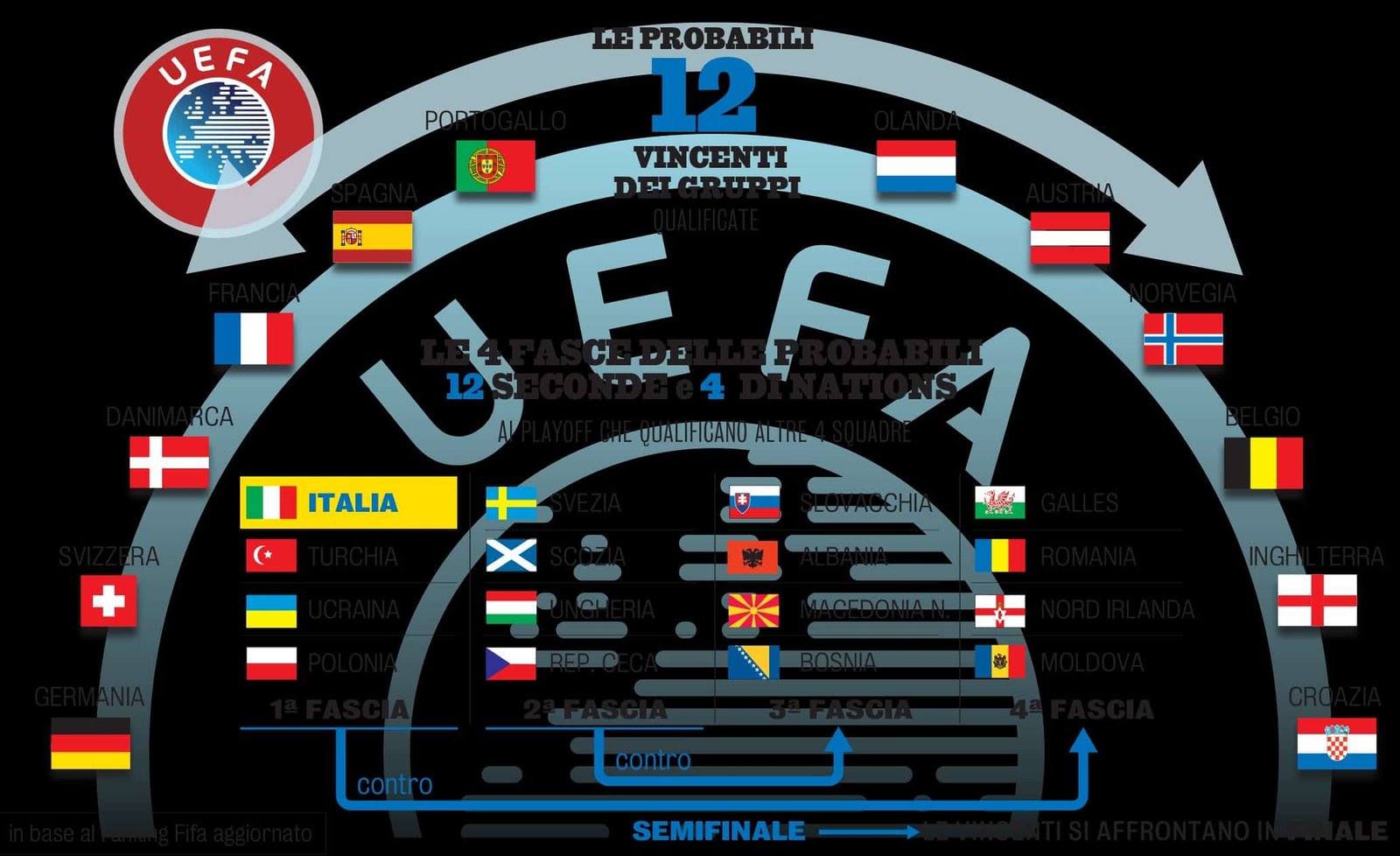
The first— The picture of the 12 winners, who qualify directly for the World Cup, is becoming increasingly clear. Nine groups are close to being official: Switzerland (B), France (D), Spain (E), Portugal (F), Netherlands (G), Austria (H), Norway (I), England (K), and Croatia (L). The situation is more competitive in the other three groups. In Group A, Germany is the favorite on paper, provided they win their away game in Northern Ireland the day after tomorrow. In Group C, Denmark is the favorite. Tied on points with Scotland, it has three more fairly secure points against Belarus and will go into the last game in Glasgow with a goal difference advantage: it could afford to lose. Finally, there is confusion in Group J, where Belgium, between Kazakhstan and Liechtenstein, can consider itself at 17 points: it will not be easy for North Macedonia and Wales to overtake it.

The runners-up— The picture is more complex for the runners-up. Northern Ireland is back in the running, while Slovakia has lost ground in Group A. In Group B, Sweden is favored over Kosovo and Slovenia, but… Scotland is in Group C. Ukraine is coming off a win in Iceland, but there is a return match (D). Turkey is ahead of Georgia and faces a direct challenge in Izmit (E). Hungary is one step ahead of Armenia (F). Poland is in Group G. Bosnia is ahead, but Romania’s victory over Austria raises hopes (H). Italy in Group I. Macedonia ahead of Wales (J). Albania one step away, Serbia needs a result at Wembley to have any hope (K). Czech Republic, with Gibraltar to secure points (L).
The playoffs— The last four European places are assigned by playoffs between the 12 runners-up and the four best winners of Nations not qualified. These 16 teams will be divided into four pots for the draw on November 21: the top three ranked by FIFA, the bottom four by Nations League. Based on our predictions, this would be the composition (with updated rankings). Pot 1: Italy, Turkey, Ukraine, Poland. Pot 2: Sweden, Scotland, Hungary, Czech Republic. Third: Slovakia, Albania, North Macedonia, Bosnia. Fourth: Wales, Romania, Northern Ireland, Moldova. There will be four mini-groups of four teams. The semi-finals between first and fourth and second and third (March 26) will be played at the home of the best teams. The finals will be played on March 31 between the winners, at a venue to be decided by draw.

crossovers— However, the story could change. If Sweden—temporarily overtaken by Poland in the rankings—misses out on second place, it will automatically go into the fourth pot, with the risk of facing Italy again, as in the 2018 World Cup qualifiers (Italy was eliminated). If Wales finishes second, it will be among the top seeds. If Ukraine fails to achieve its goal, there will be a promotion from the second pot to the top seeds… It’s a hypothetical game of dominoes that is best not to continue, but it gives an idea of the overall complexity of the situation. Including the fact that at the final draw on December 5 in Washington, there will be 42 teams plus 6 “X”s in the last group: these indicate the 2 winners of the World Cup playoffs and the 4 winners of the European playoffs. We have to be an X.