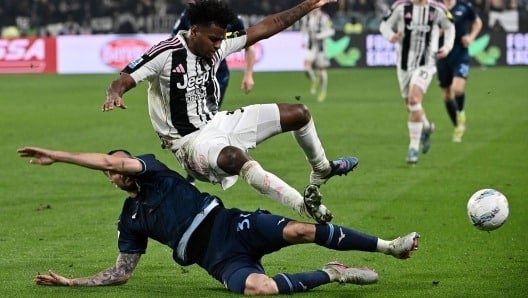
After the Juventus coach’s statement (“There are 22 professionals and one precarious worker on the field”), let’s do the math: €4,000 gross to referee a Serie A match (€1,700 for VAR). Fenucci, in Bologna: “We need a discussion between the parties.”
Professionalism in refereeing? A new chapter is beginning, but for now it’s still… old. Luciano Spalletti, Juventus coach, opened the door wide after the 2-2 draw against Lazio. “There are 22 professionals and one precarious worker,” said the coach. The referee is not a professional: he goes home, has to think about other things, and doesn’t know if he’ll still be refereeing next year. That’s not right; he’s the most precarious person on the field.” It’s an old story, but one that needs refreshing. And the question is: how much do referees earn in Serie A and B?
Earnings— The table is clear. To referee a Serie A match, a referee earns (gross) €4,000. The net amount is self-evident. In Serie B, €2,000. And then, the VAR in Serie A “earns” €1,700 per match and €800 in Serie B. As fourth official, €500 in Serie A and €200 in Serie B. For assistants, €1,400 in Serie A and €600 in Serie B. For AVAR, €800 in Serie A and €400 in Serie B. In addition to this, there is a fixed annual amount: €30,000 for those with fewer than 50 appearances, €60,000 for those with more than 50, and €90,000 for international referees.
in europe— In Europe, remuneration for international referees increases according to UEFA tables: taking into account competitions on our continent, those appointed to referee a Champions League match receive compensation ranging from €6,000 for the round of 16 to €7,500 for the quarterfinals and semifinals, rising to €10,000 (gross) for a final (€3,000 for assistants and €4,000 for VAR). At the women’s level, a Champions League final is worth €5,000.
Elite group— In the recent past, there has been talk of creating an Elite Group: lately, the idea has not been taken into consideration, but if it were to be created, it would certainly be a select group (like today’s Can A and B) but with organizational autonomy, a way to achieve professionalism (including severance pay, to be clear).
Independence— Meanwhile, Deputy Vice President Francesco Massini has issued a statement. “The Italian Referees’ Association (AIA), in relation to some statements and articles in today’s press on the subject of the professionalism of referees, wishes to clarify that it has never been opposed to proposals for reform in this direction. The objective remains, in fact, to preserve and bring back to the center of the system a refereeing function endowed with authority, charisma, and strong personality, capable of making decisions independently, without being subordinate to the pressure of technological tools. Working together with the FIGC and the leagues on such a reform is not only possible but was even considered desirable at the time, in order to build a reform that is shared and sustainable, including from an economic point of view,” concludes Massini.
Bologna CEO Claudio Fenucci also expressed his opinion on the subject, disagreeing with the red card given to Pobega in Parma-Bologna (“The referee made the right decision with the yellow card, it was not a disproportionately violent tackle”) and starting with the function of VAR. “VAR was created for clear and obvious errors, but it seems to have turned into a slow-motion replay, intervening in every possible situation. Everyone is complaining, and I don’t think the fans like it either. Next year, the parties involved, clubs, and referees will need to meet, perhaps even evaluating VAR on demand as in Serie C (FVS, football video support, ed.): there needs to be consistency between VAR and the field. Professionalism can help referees; it is a path that can help them, with a defined budget, to train better and prepare in the best possible way.”