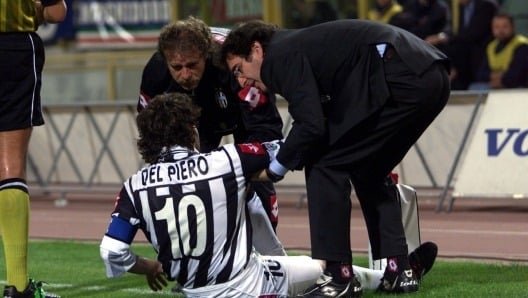
He is part of the history of the Bianconeri club: “He’s certainly not the doctor who wins cups and championships, but he sits on the bench and plays a major role in the day-to-day dynamics of the team.”
He has made countless runs onto the pitch, almost like a striker: “But fortunately, I’ve never pulled a muscle…” Fabrizio Tencone was much more than a doctor for Juventus; he is a piece of history. Thousands of knees, shins, and ankles have passed through his hands. A veritable jewelry box of players: from Vialli to Del Piero, from Zidane to Pirlo… In two different periods (1995-2002 and 2010-16), he lifted every type of trophy with the Bianconeri: “He’s certainly not the doctor who wins cups and championships, but he sits on the bench and plays a major role in the day-to-day dynamics of the team,” says the director of Isokinetic in Turin.
Your first time on the bench?
“February 1995 in Sampdoria-Juventus 0-1, goal by Vialli. In July 1994, I started the season as the Primavera team doctor, then in February I was promoted to the first team because a doctor left the club. As soon as I sat down on the bench, Lippi made me smile with one of his jokes: ‘Doctor, we’re top of the table. Let’s not…’. Marcello was ‘physiologically’ superstitious, but not excessively so. He was attentive to everything, to every detail. Even medical issues. Not all coaches are like that: I know some poor, ill-prepared coaches who underestimate health issues. I was lucky: I worked with the best: Lippi, Ancelotti and, in my second spell at Juventus, Conte and Allegri.“
The most hypochondriac player?
” I’ve had several, but they’re not difficult to manage. The real trouble is serious injuries. I couldn’t sleep at night because of Buffon’s back injury. Not because I was afraid, but because I was aware of the problem: it wasn’t a given that Gigi would come back as he was before. He surprised everyone, including me: after his surgery in 2010, it was a bit like he had started a second career, but still at the top. He’s an extraterrestrial. I’ve rarely seen players so determined: he had already won the World Cup, yet he was doing three therapy sessions a day.“
The most painful cases: Buffon’s back pain, along with Del Piero’s serious knee injury and Ferrara’s tibia injury?”
Was Buffon’s case the most painful?
“Along with Del Piero’s serious knee injury and Ferrara’s tibia injury. Gigi, Ale, and Ciro are also among the players I bonded with the most.”
While examining a player, did you ever think, “There’s a lot of money at stake here…”?
“The perception of having players worth millions in your hands is always there, but in those moments, your priority is the health of the players; nothing else matters. Ferrara was the funniest of them all; he had a joke for every situation. When I went to help him on the field, I could see in his eyes that he was really hurt: in fact, he had broken his tibia.“
Was there a player who was allergic to doctors and massage therapists?
”Vierchowod was like he was on the field, tough and pure. I don’t think I ever saw him on the massage table; he was an old-school player.”
Zidane sometimes left you speechless. He did some crazy things.“
How patient was Zidane?
”Polite, an exquisite person and easy-going. People enjoyed his magic in matches, but I am one of the lucky ones who was able to admire him in training too: sometimes he left you speechless. He made some crazy moves.“
The most creative player?
”Thuram. A beautiful man, always dressed elegantly, even for training: long clothes, almost like capes.” .
And Davids?
“Edgar was brilliant: he turned a visual impairment and the need to play with glasses into an iconic trait. A life experience that goes beyond soccer.”
Do doctors also play a role in the transfer market?
“In the past, when there was less information available than today, it was normal to gather information on players targeted by the club to understand their injury history. Moggi was always very wise, even from this point of view. I also remember Pirlo’s free transfer in the summer of 2011, during the Marotta and Paratici era. Andrea was coming off a season with several injuries at Milan: he arrived at Juventus and didn’t miss a game. It was a huge satisfaction. Credit also goes to Conte, the coach that year: Antonio has a degree in sports science and is very knowledgeable about human physiology. Several studies have proven that good communication between the technical and medical staff helps reduce injuries.” ‘
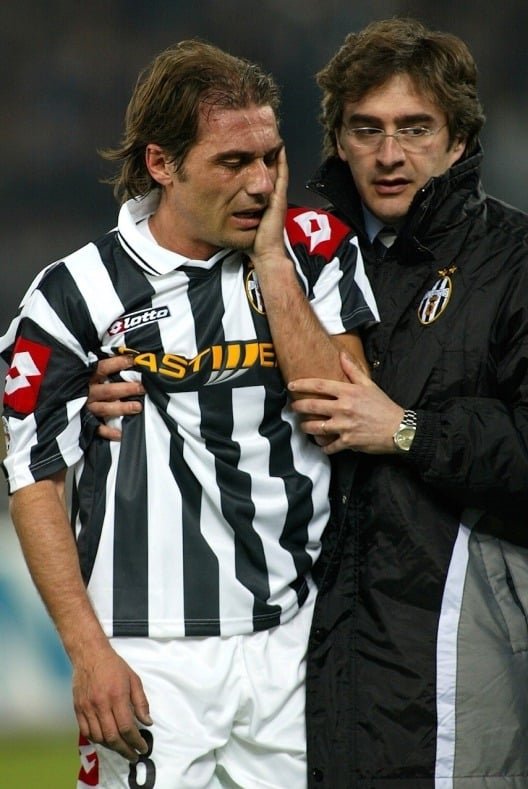
When you think back to Conte as a player?
“The first thing that comes to mind is the Champions League final won in Rome in 1996. Antonio got injured against Ajax. On our return to Turin, everyone was celebrating. Except for Conte and us doctors, who went to the hospital instead. Antonio was disappointed about his thigh injury, but his satisfaction at winning the Cup was more powerful and effective than any painkiller.”
Could you go back?
“I would change two games. The Champions League final lost to Borussia Dortmund and the Scudetto that slipped away in the downpour in Perugia. At the Curi stadium, it was like being in a movie: locked in the locker room, time seemed to stand still. Some were chatting, others remained silent and asked for new bandages. I will never forget the looks on the faces of former players Reuter and Kohler in the final against Borussia Dortmund: for them, it was an incredible revenge. But in reality, the only thing I would really like to change is the results of Andrea Fortunato’s first blood tests, as leukemia took him away too soon. He is a guy who will always be in my heart.”
Do you ever think about a final dance in soccer?
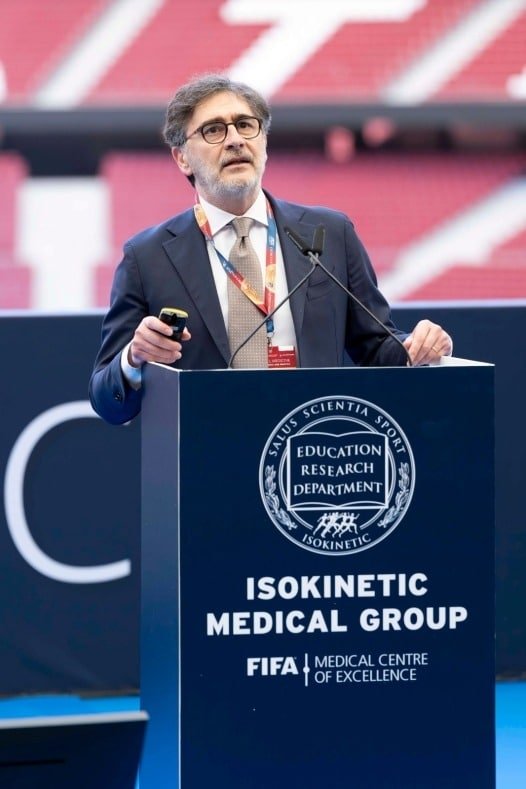
“The chapter isn’t closed, but it’s very much closed. Even now, when I watch a game on television and see a player on the ground, my first thought is the possible diagnosis. It’s professional deformation, not nostalgia. I gave a lot to soccer and got a lot out of it. But now I find satisfaction in being everyone’s doctor, not just the players’. I’m the director of Isokinetic in Turin, I teach at the university: I like treating patients and educating future generations of doctors.”