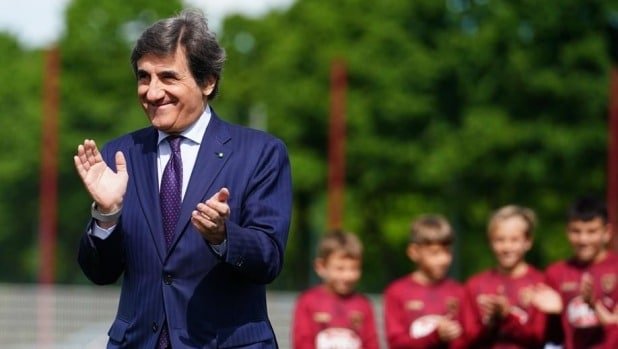
On September 2, 2005, he became president: there was a shortage of balls and jerseys, and some people wanted only one club in the city…
When Urbano Cairo saved Torino twenty years ago, the Filadelfia stadium was in ruins. Virtually nothing remained of the stadium that had witnessed the triumphs of one of the greatest teams in history and had then become the cradle of so many young Granata talents. Old fans went there on pilgrimage, sighing with melancholy or raging: was it possible that the legend had been trampled on like this? Some talked about Valentino Mazzola, about when he rolled up his sleeves and no one could stop him, or about Pulici and Graziani, the twins who scored the goals that won the 1976 championship; Others, less poetic or perhaps just younger, remembered the pizzas that Bobo Vieri devoured as a boy in the little bar in front of the Fila, one after another, at the end of training with the Primavera.
Toro was also in ruins twenty years ago. People talked about prosecutors rather than goals, about false accounting rather than false nines, i.e., center forwards. Cimminelli’s management had brought the club to collapse at the end of a long period of suffering, with presidents targeted by the justice system, uncertainties about the present and future of the club, anxieties, and humiliations. And after Torino’s bankruptcy, some people had plans for a single team in the city. Cairo became president on September 2, 2005. There was a meager roster with nine players and five Primavera boys, the coach was Stringara (the first choice of the new owner would later be De Biasi), and there was not even a trace of balls or jerseys. When he took over, Torino was about to face its seventh Serie B championship in ten years. In short, it was in the darkest period of its history.
It was Sergio Chiamparino who, in August twenty years ago, asked Urbano Cairo for help. They shared a passion for the Granata club, and the mayor of Torino wanted to meet him to convince him to take over the club, get it out of trouble, and restore its security and dignity. Cairo was leaving for Forte dei Marmi and promised to think about it during his vacation. His love for those colors had always been deep, passed down to him by his family, as his mother and father were huge Torino fans, but the operation was complex and the commitment burdensome, especially for someone who had always experienced soccer only as a fan (and, in his youth, as a player, “I was a nimble right winger but I was a little too emotional”). When Chiamparino called him again while he was in Versilia, Cairo discussed it with his wife. He recounted in an interview with Sports-Predictions dello Sport: “I told her: I’m going to pop over to Turin, the mayor keeps calling me, I’ll explain that I don’t feel up to taking over the club and I’ll be right back. But she saw that I was putting three shirts in my suitcase. She asked me, ‘Excuse me, but you weren’t supposed to go and come back, so why so many shirts? That summer in Forte dei Marmi, they never saw me again.”

Italians—Urbano Cairo has become the longest-serving president in the history of Torino, surpassing Orfeo Pianelli’s nineteen years. Few others have remained at the helm of important clubs for so long in Italian soccer: Ferlaino at Napoli and Berlusconi at Milan have reached thirty-one years; two presidents still in office, De Laurentiis and Lotito, took over Napoli and Lazio a year before Cairo, in 2004, and they too managed to remedy club situations that were on the brink of disaster. Italian owners have charted a virtuous course just as clubs in foreign hands, including investment funds and the like, become the majority, eleven to nine. There are often protests, but this happens everywhere, even after winning a championship, perhaps because expectations exceed what revenues (now determined mainly by television rights) can allow. However, there are many—albeit silent—who understand and appreciate careful, secure management aimed at protecting the future.

Twenty years— During this period, Torino has become something else. The Filadelfia is somewhat symbolic of this change: reborn after almost twenty years of controversy and broken promises, it is now an increasingly modern training facility, allowing the Granata fans and players to continue to tread the ground on which the club’s century-old history was built. Investments have been made to facilitate the work of today’s team by leveraging the strength of the past. The Robaldo sports center, the new home of the youth sector, is now operational and should be completed within a few months. It is there that the talents of the future are being nurtured, in keeping with Torino’s tradition. After all, among the highlights of the Cairo era are the excellent results of the youth academy, from the Primavera’s return to the Scudetto to the conquest of the Coppa Italia and Supercoppa, to the championships won last season by the Under-18 and Under-17 teams. This led to six young players making their Serie A debut in the last championship. The club’s financial stability now allows it to have growing sporting ambitions. Torino has played in Serie A for fourteen consecutive seasons, most of which ended in the left column of the table, and has returned to Europe twice (the victory at the legendary San Mamés in Bilbao is a feat never achieved by an Italian team). The era of folly and failure is over; today, football must be sustainable: history and solidity, Filadelfia and a guaranteed future.