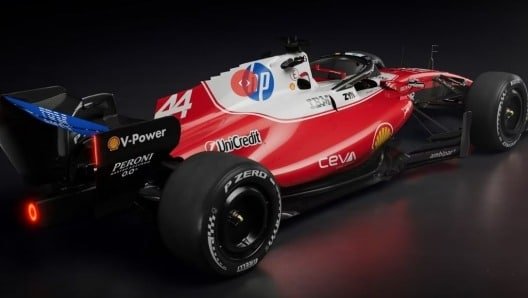
Let’s discover the main details of the Prancing Horse’s new single-seater: great care has been taken in the design of the sidepods, which show particular attention to airflow. On the front profile, the actuators that change the angle of the flaps (active aerodynamics) are integrated into the side bulkheads.
Ferrari has unveiled the new SF-26, the single-seater with which the Scuderia will tackle the 2026 season, characterized by a major regulatory revolution in terms of aerodynamics and power units. The first images of the SF-26 reveal some distinctive elements of the design, although it is correct to consider the current version a transitional one compared to the one we will see in Melbourne at the first race. Not only has the push rod system been adopted at the front and rear, thus abandoning the pull rod system at the front, which on the SF-25 never gave the drivers the right feeling when cornering.
Starting with the front wing, it is interesting to note not so much the shape of the profiles as elements such as the actuators that modify the angle of the flaps by activating active aerodynamics, incorporated into the side bulkheads. The nose cone is connected to the wing by short curved pylons. But the most interesting part, which highlights solutions that are not sketchy but deeply thought out, is at the sides, where the air intakes, positioned high up as on the previous car, conceal a bypass duct deep below the entrance, which then vents at the base of the engine cover. These elements give us the impression, if we examine them together with the dynamic intake of the Power Unit, which is almost triangular in section with rounded edges, but above all extremely small in size compared to the competition, that the study of the internal fluid dynamics of the SF-26 has followed very different paths compared to the other single-seaters seen so far.
serrated fin— In essence, this provides a very important clue as to the accuracy that has been paid above all to the packaging of the power unit and its radiators and heat exchangers. The rear of the car, on the other hand, appears very narrow, especially in terms of rear hot air venting, denoting attention to flow management, which will in fact also be instrumental in extracting air from the bottom of the car through the diffuser. The voluminous fin on the engine cover is interesting, as it partly replicates last year’s fin, which had a serrated profile. Finally, the reduction of the wheelbase to 3400 mm, as required by the regulations, has resulted in a tangible, albeit not excessive, rearward shift of the cockpit. Ultimately, this is a single-seater that hides many refined features under a provisional guise that will undergo substantial changes before Melbourne.