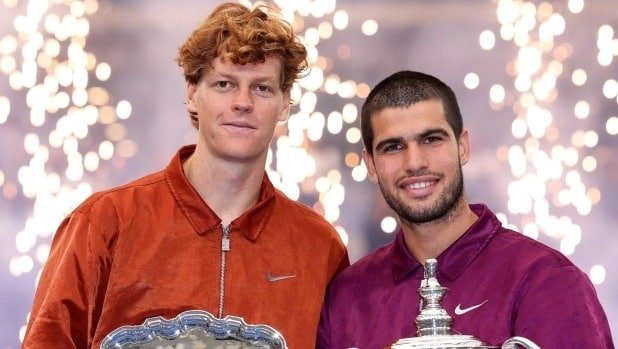
In the 15 matches between Jannik and the Spaniard, Carlos clearly has the upper hand, but out of 3,152 points played, the difference is practically nil
As usual, he was the most lucid: Jannik Sinner. After his defeat in the final against Alcaraz in New York, the Italian tennis player analyzed what had happened at the US Open and also pointed out the way forward to avoid a repeat not of the defeat (that’s part of the game and must always be accepted, especially if the Spaniard is on the other side of the net) but of such a marked feeling of inferiority. The set he won was more a result of chance and his usual perfect attitude even on the darkest days: as soon as Alcaraz left a gap (the first break point), Sinner turned it into a breach (breaking his rival’s serve) and then a door (winning the set). But there was no time for illusions, and we are quite convinced that even Jannik, always very attentive to the sensations coming from the court, did not really think he could win. The fifteenth match between the two dominators of world tennis, therefore, marked a first turning point: there had been many beautiful and important matches, but the one in New York took the rivalry to the next level. It will not be the last: Nadal and Federer have faced each other 40 times (24-16), Djokovic and Roger 50 times (27-23), and Nole and Rafa 60 times (31-29). Jannik and Carlos may approach or exceed those figures, but there will be two or three decisive moments in their careers that will determine the legacy they leave behind. As happened to both of them this summer: after his defeat at Wimbledon, Alcaraz spent two weeks studying the tactics needed to beat Sinner, and the Italian will do the same after his clear defeat in New York.
In the first fifteen matches, 3,152 points were played: Alcaraz won 1,579, Sinner 1,573. Six points difference is nothing. But points, like goals, must be weighed and not just counted. Jannik is forced to make some changes based on the overall balance of the matches: 10-5 for the Spaniard, and even 7-1 in the last eight matches. Cincinnati does not count for the Italian’s physical condition (even if the Spaniard seemed more focused during the tournament), and a victory could have been achieved at Roland Garros, as we unfortunately remember well. But the underlying concept remains unchanged: in head-to-head matches so far, Carlos has had something extra. As a result, Jannik will work on his tennis to reduce the gap, even at the cost of throwing away a few matches against inferior opponents. Training is essential, and Simone Vagnozzi will accompany the player in this technical and tactical evolution. But only the tournament will provide the answers we are looking for, because competition tests every aspect, including athleticism, where further growth is needed: Alcaraz forces Sinner to raise the intensity to the maximum level from the first to the last point, and the matches are always very tiring. Let’s not expect revolutions: that would be absurd. Jannik’s tennis is structured, the result of years of work with the aim of exploiting his visual and biomechanical qualities. There is talk of change, but it would be more appropriate to talk about enrichment. That is why the tactical aspect should be emphasized: Sinner can train a shot a lot (the backhand, the volley, the drop shot), but if he is not convinced to use it, it is as if he does not have it in his toolbox. At times, it seemed that Jannik only used his famous variations when he was in control. Instead, he should use them more when things are not going so well. As always, it all starts in the mind, and in that sense, his words in the belly of Arthur Ashe Stadium leave us feeling reassured.
What Sinner needs to improve— Sinner is a guy who makes decisions and goes his own way: that’s how it was when he left Piatti and chose Vagnozzi, when he wanted Cahill on his staff, when he dropped Panichi and brought Ferrara back after some negative feelings he had on the court between Rome and Paris: even though he had played two consecutive finals after a long break, he had the feeling that something was wrong. Now is the time to work on his game and, above all, on those details that make the difference. The serve, of course, is the easiest example because it is the only shot that does not depend on the opponent: he needs to increase his percentages and effectiveness (serving well gives confidence, it doesn’t just bring points), above all ‘clean up’ his movement by working on his wind-up (moving his arm behind his back) and ball toss. These are details that make the difference and that need to be incorporated into Sinner’s usual game. A year and a half ago, for example, he was very good at incorporating different trajectories into his baseline rallies. The ultimate goal is to beat Alcaraz, of course. But the most important goal, because it gives meaning to every training session, is the constant search for improvement: Jannik wants to present an even better and different version of himself and push his limits a little further. There is nothing more rewarding in sport.