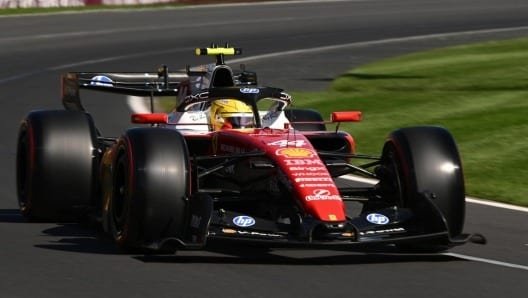
During free practice in Australia, the two teams’ hard work in adapting pace and set-up to the battery was already evident: the Scuderia and the Silver Arrows appeared to be ahead of Red Bull and McLaren.
The red light on the rear axle flashes on and off, the sound changes tone when exiting corners, and the car slows down where you wouldn’t expect it to. It might seem like the behavior of an indecisive car. Instead, this is the 2026 edition of F1. The drivers and engineers are simply acquiring data and setting parameters that have become fundamental, those of the energy recovery cycle. Today in Melbourne, Ferrari dedicated most of its work on the track to this activity, which is likely to be more important than aerodynamics and pure power. Overall, it gave an impression of general completeness that bodes well.
Today, the two SF-26s completed the longest stint of the day on hard tires, delaying the use of soft tires compared to Mercedes and McLaren. The reason is clear: Maranello was trying to identify the points on the track where battery charging could be optimized through so-called super clipping, i.e., the regime in which the MGU-K draws energy from the rear wheels while the driver is still at full throttle. Each team chose different points on the circuit to recharge: McLaren, for example, concentrated super clipping between turns 9 and 10, while Ferrari moved it further ahead, between turns 10 and 11. This difference generates different speed peaks in the various sectors, making it almost impossible to read the actual performance until the lap is completed. Aware of the risks associated with sudden slowdowns on a narrow track like Albert Park, the FIA decided to lower the recoverable energy limit in qualifying from 8.5 to 7 megajoules, precisely to discourage overly extreme recharging strategies on the flying lap.
But the impression gathered in the paddock is that the real values should be read in context: the real game will be played on energy management during the race, where a well-calibrated recharging cycle allows you to preserve the tires and maintain a constant pace, while a wrong compromise will result in early degradation. The most interesting indication from Friday in Australia is that the leading group seems to be divided into two pairs: Ferrari and Mercedes on one side, McLaren and Red Bull on the other. Hamilton, in particular, appears comfortable in a car that has less downforce than the SF-25: his driving style, capable of recovering the car even when it slips without losing too much time, is naturally suited to a car that is less “on rails.”
response in the race— Red Bull, despite having the new Ford power unit, did not seem entirely comfortable, probably also due to a charging cycle that still needs to be refined. McLaren showed single-lap speed with Piastri, but the indications on the long run—where energy cycle stability counts—suggest that race pace may not yet be at the same level, despite having the same Mercedes engine. The answer that really matters will only come on Sunday (Australian GP schedule), when energy management will become the fine line between competitiveness and vulnerability for 58 laps. For Ferrari, the foundation seems solid. How solid it is remains to be seen.