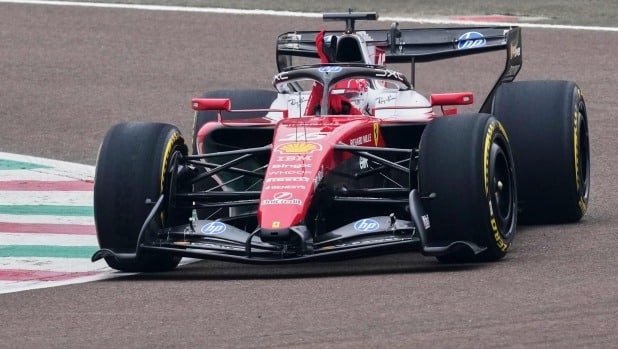
The internal combustion engine and electric components passed muster on the second day of testing at the Spanish circuit, where the new red car took to the track: 64 laps for Leclerc and 58 for Hamilton, even though the weather was not helpful until midday.
Charles Leclerc made his debut in the SF-26 on the morning of the second day of testing at Montmelò, managing to complete a total of 64 laps. The work plan for the Monegasque driver and Hamilton, who took his place in the afternoon session, included a series of checks partly related to the power unit modes but also, weather permitting, an initial analysis and familiarization with the active aerodynamics. In this regard, it is worth noting that only Leclerc was able to begin an initial procedural roughing out, especially in terms of driving automatisms, testing the third aerodynamic configuration, known as Partial Active Aero Mode, which is in fact a middle ground between the straight configuration, Straight Mode, and the Standard configuration, or Corner Mode, and was approved by the last FIA World Council last December. This was particularly relevant given that, with the exception of the first few laps, the track was wet with rain showers throughout the morning, before drying out, albeit not completely, before the lunch break.
Ferrari’s program was therefore not completed, but tests related to different modes of use of the PU (power unit) and visual analysis of fluid flow through the extensive use of flow viz on the rear wing marked Leclerc’s various outings from the pits. Hamilton, on the other hand, carried out his tests mainly on a wet track with poor grip, completing a total of 58 laps, so the predominantly dynamic part of the tests will certainly be carried out in the two days remaining available to the Scuderia, until Friday. In any case, bearing in mind that performance was certainly not the objective, not only due to the changeable weather conditions, a significant factor concerns the reliability of the PU, which already on the first day of this session had shown, with Haas and Cadillac, a total absence of critical issues in this regard, both in terms of the internal combustion engine and the electrical system. This is an important step forward in this preparatory phase, where there are several question marks that the teams will try to answer during this session and the next two in Bahrain. Ferrari’s work plan for the two days remaining before the end of its tests will focus on the dynamic analysis of the car, with extensive data collection on the suspension and aerodynamic performance in terms of analyzing the distribution of the load generated. The use of the PU will continue to be evaluated in different scenarios, especially during long runs, specifically in terms of energy recovery linked to the various systems connected to this function, starting, of course, with regeneration during braking.